Pages

Sunday, May 15, 2016

The Czech Language: No Vowels, No Problem


Overview:

The Czech language is spoken by around 10 million people in the Czech Republic in central Europe. It is a language in the Balto-Slavic branch of the Indo-European language family and thusly has many similarities to its neighbor languages such as Slovak. Czech and Slovak share a very high level of mutual intelligibility.
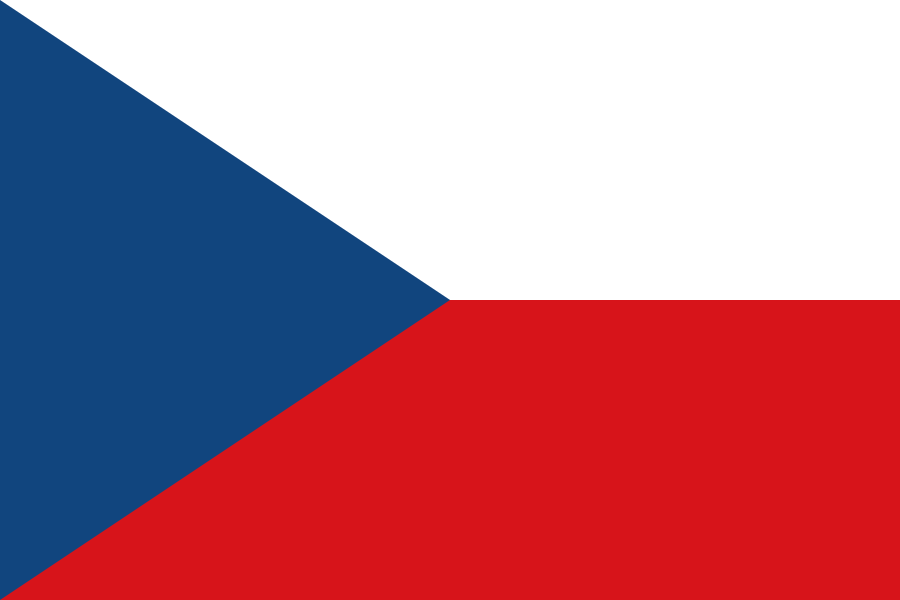
Czech Flag. Source: Wikimedia.

History:

Probably around the 6th century C.E, a group of Slavs settled in what is now the Czech Republic. Slavic legend states that this group of Slavs were led to the Czech lands by a hero named Čech, and this is how the name of the language came to be. 
A painting of the hero, Čech.
Source: Wikimedia.
Eventually being converted to Christianity by the Byzantines to the South, the Kingdom of Bohemia (as the Czech lands were known) became a Christian nation and adopted the Glagolitic alphabet in the 800s. This was eventually replaced by the Latin alphabet, the writing system adopted by most Central and Western European languages. Bohemia's membership in the Holy Roman Empire and its participation in the 30 Years' War led the Czech language to be influenced by the German language.

Characteristics:

Czech is a fusional language in which the subject, object, number, grammatical case, gender, and mood can be conveyed in one word. For example, the infinitive "být" means "to go," while the conjugated form, "byla" would mean "she went." Because of this, Czech word order is somewhat ambiguous informally. However, Czech's verb order is technically subject-verb-object. This is the same word order we saw with Turkish. This means that the sentence:

My book
fell on the ground.

Would be written as:

My book
on the ground fell.

Many Czech words also do not contain any vowels. While this might seem strange, it is actually relatively similar to the final syllable in the American pronunciation of words like "butter." The Czech phrase "Strč prst skrz krk" (stick your finger in your throat) is often used as an example of this, with a quite humorous meaning that could be interpreted as how you ought to pronounce vowelless Czech words. Note: The Czech word for "hello" is "Ahoj" (pronounced a-hoi). I love it!

Significance:

According to Wikipedia, over 70'500 people in the United States speak Czech. Outside of Austria and the Czech Republic, Chicago is actually the city with the highest Czech-speaking population in the world. Counties across the midwestern United States, particularly in Nebraska, have Czech as the most widely spoken language (other than English and Spanish) in homes. According to the FSI, Czech is a category IV language and would take an English speaker around 1100 hours of study to
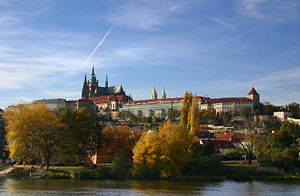
Prague Castle, Prague.
Source: Wikimedia.

become fluent in. With the Czech Republic having some of the world's most beautiful castles and landscape, and its own distinct culture, the Czech Language could be a great tool for travel and life in Central Europe. As they say in the Czech republic, na shledanou!

Our video this time is of Dana from the Youtube channel, Wanted Adventure. She is an American who now lives in Munich, Germany, but originally moved to Prague from the US.

Sunday, May 1, 2016

The Turkish Language: Agglutination is Great


History:

     The Turkish language is the widest-spoken language of the Turkic family with over 75 million native speakers. Being part of the larger Altaic language family, Turkish is primarily spoken throughout Southeastern Europe, (specifically in the Balkans) as well as its country of origin, Turkey. Being the official language of the Ottoman Empire, one of the largest Islamic empires of all time, Turkish experienced an influx of vocabulary from the Persian and
An example of the transliteration of the Turkish
language into the Latin Alphabet, 1930s.
Source: Wikipedia
Arabic languages around 1000 A.D. Largely being used in official matters, this "Ottoman Turkish" lasted throughout the lifespan of the Ottoman Empire until its collapse after WWI. Subsequently, many of the words of Persian and Arabic roots were replaced with Turkish words as an effort to reform and purify the language. Changing from an Arabic writing system to a modified Latin alphabet in the 20th century saw the Turkish language's availability as a second language increase throughout Europe.

Characteristics:

     Being an agglutinative language, Turkish is vaguely grammatically similar to languages such as Japanese and Korean insofar as it can be used to express ideas in as few as one word. "Morphemes," or "particles of language from which a meaning can be derived," are combined with stem words to express the object, situation, and response to said stem. Words can essentially be compounded upon over and over, meaning that something that would require a sentence to be expressed in English may only be a
The Flag of Turkey.
Source: Wikipedia
 single Turkish word. The Turkish word order is Subject-Object-Verb (in comparison to the English Subject-Verb-Object.) This means that the English sentence:

The dog
ran to the corner.

Would be written as:


The dog
to the corner ran.


Significance:

Being the most widely spoken Turkish language, Turkish is the 20th most known language in the world (counting both native and second-language speakers.) With Turkey occupying the entirety Anatolia, it is a country with a very long and deep history. Historical monuments, architecture, and rich Turkish culture give Turkey a cultural identity that can be fully experienced with knowledge of the Turkish language. Being a category IV language (according to the FSI,) the Turkish language is rather difficult to learn for English speakers, mainly due to its foreign agglutinative nature. However, Turkish can be learned (with motivation) relatively easily due to its familiar alphabet and straightforward word order. Resources like Duolingo offer Turkish lessons, free of charge. Have a good day, and hoşça kal!


Paul Jorgensen on the Youtube channel "Langfocus" has an excellent Turkish language video (see above).